
Part 1—Gamble & Huff: Ride to the Sky for Philly Soul
SOUL SECRET INGREDIENT: GAMBLE & HUFF
They didn’t belong in the Shubert Building—or so it felt. Two young Black men stepped into the Philadelphia hub buzzing with music, ambition, and possibility. But the sound pulled them in. Leon Huff was already inside, earning fifty dollars a week as a songwriter, when an elevator ride changed everything. There stood another Black kid, guitar in hand. His name was Kenny Gamble, he had a band, and was trying to make a record on the sixth floor. In a building where they were almost never seen, they found each other—and in that fleeting moment, the future of Philly Soul quietly took shape.
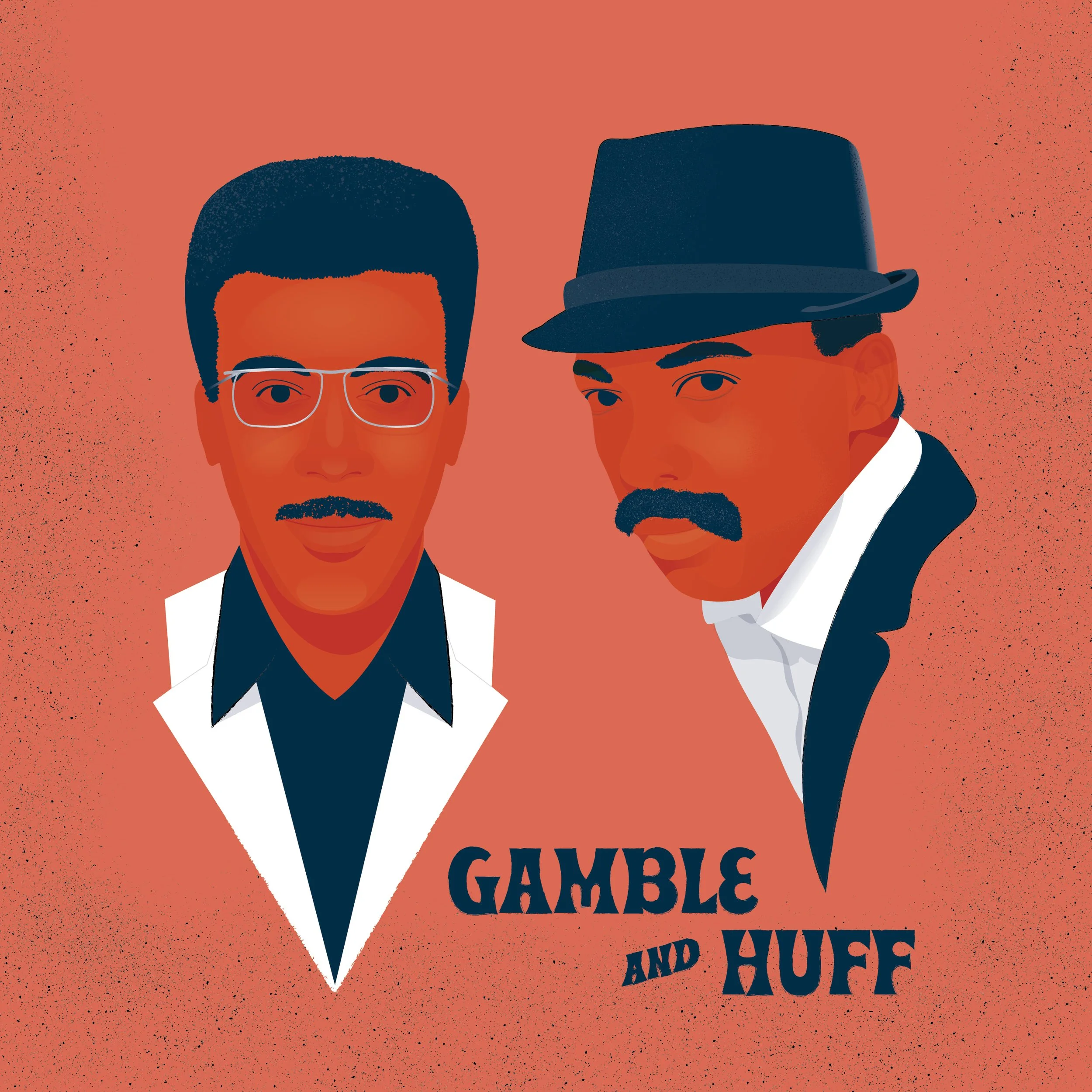
Kenny Gamble & Leon Huff. Illustration by J.D. Humphreys
• WRITING PARTNERS TOGETHER IN A CREATIVE PROCESS •
“That building was sort of like the Brill Building in New York,” said Leon Huff. “It was a music place. “I wasn’t thinking about nothing else.” He took on a side job in a hospital kitchen to make ends meet in addition to working gigs during the weekend. When he was called to sessions in New York, he would drop everything, including his shift in the kitchen. “I’ll hustle me up money to get to New York. I wasn’t thinking about washing no dishes in no kitchen.”
Their collaboration took off. “We must have wrote six songs together one afternoon,” Gamble said. “Good songs. That was a match made in heaven, because every time we saw each other, we’d get together again. Every time we would sit down to write, it was just so fluent.”
“That was a match made in heaven, because every time we saw each other, we’d get together again.”
- Kenny Gamble
Gamble and Leon Huff officially joined forces for the first time in the studio, with Huff on keyboards, recording a track for Candy & The Kisses. Huff slid right into Kenny Gamble and the Romeos, taking over on piano when Tommie Bell left for Cameo-Parkway to work with Chubby Checker. Huff had already tasted the industry—briefly crossing paths with Phil Spector’s studio in 1965—and learned how quickly glamor met reality. The band was tight, the crowds were responsive. “We had a great band,” Huff said. “And Gamble was good. I mean, Gamble was like… we had the girls.”
LISTEN TO “THE 81” BY CANDY & THE KISSES
They worked the college circuit hard, playing fraternity parties and even touring alongside Little Anthony and the Imperials. But for Gamble, the road and the spotlight never quite fit. He bristled at travel, resisted being the frontman, and sensed his gifts belonged somewhere else. When the band eventually scattered, Gamble and Huff stayed put—turning away from the stage and toward songwriting, where something far bigger was waiting.
LISTEN TO “AIN’T IT BABY” BY KENNY GAMBLE AND THE ROMEOS
“Every day we would write songs and talk about songs, talk about the strategy of how to be competitive in such a competitive business where everybody is trying to get that number one record,” Gamble said. “We were really trying to be original in our approach to the music. We always spoke of our songs in the context of classics. Let’s write songs that will be around forever.”
Gamble also points out that the key to their songwriting success was they were very critical when it came to their work and did not belabor something that was not working. “They would be written, some of them many be twenty minutes, they’d be done,” he adds.
A typical writing day for the pair began comparing notes, song ideas, and possible titles they collected had on their own. Out of those fifty or so ideas, they plucked what that thought was interesting and just started playing. These sessions often resulted in ten songs to consider for further development. “One thing we always did was we talked,” said Huff. We talked about everything, really, you know, current events and all that. And Gamble’s approach to songwriting was positive messages… of course he was writing love songs too, dance too. But we had to have some songs in there to inspire in different ways, you know.”
• GAMBLE & HUFF IN FULL DEMAND •
Philadelphia DJ Jerry Blavat made the introduction to the Soul Survivors—a band in urgent need of a hit for Blavat’s co-owned Crimson Records. The result was Gamble and Huff writing “Expressway to Your Heart” in 1967, a sleek slice of blue-eyed soul that broke new ground. According to Huff, it marked the first time two Black producers crafted a record for a white act. The song roared up the charts, landing at No. 3 on the R&B chart and No. 4 on the Billboard Hot 100, and anchored the album When the Whistle Blows Anything Goes, also produced by the duo. It became Crimson Records’ biggest release—and the moment Gamble and Huff truly arrived.
LISTEN TO “EXPRESSWAY TO YOUR HEART” BY THE SOUL SURVIVORS
Deepening what would soon be known as the Philly Sound, Gamble and Huff wrote “Cowboys to Girls” for the Intruders—a defining moment that became the group’s biggest hit, reaching No. 6 on the Pop chart and No. 1 on the R&B chart in 1968. “That sort of established me and Gamble as Gamble and Huff,” recalled Huff. They were soon tapped to write for Houston’s Archie Bell & the Drells, following the seismic success of “Tighten Up,” a double No. 1 record and one of funk’s earliest breakthroughs, written by Bell and bandmate Billy Butler and backed by the TSU Tornadoes of Texas Southern University.
LISTEN TO “TIGHTEN UP” BY ARCHIE BELL & THE DRELLS
As “Tighten Up” surged up the charts, Bell was deployed to Vietnam, unable to tour or promote the record. Atlantic Records’ Jerry Wexler stepped in to orchestrate a follow-up and chose Gamble and Huff to carry the momentum forward. Bell, wary of the notion that “nothing good every came out of Texas”—a feeling heightened in the wake of Kennedy’s assassination, according to The Billboard Book of Number One Hits by Fred Bronson—was determined to prove otherwise. “We were from Texas and we were good,” Bell insisted. Even a leg injury sustained while stationed in Germany couldn’t slow the group, who rushed out a single and an album before the moment slipped away.
“I thought Archie was so unusual,” said Gamble. “He had a great, unique voice and the way we got hooked up with Archie Bell was through Atlantic Records, they called us up and asked if we had anything. We put him in the studio and Huff and I wrote a song called ‘I Just Can’t Stop Dancing.’ It was a good one, a nice dance record.”
“I thought Archie was so unusual. He had a great, unique voice and the way we got hooked up with Archie Bell was through Atlantic Records, they called us up and asked if we had anything.”
- Kenny Gamble
Almost as successful, “I Can’t Stop Dancing” released in the summer of 1968, climbed to number nine on the Billboard Hot 100 and number five on the R&B chart.
LISTEN TO “I CAN’T STOP DANCING” BY ARCHIE BELL & THE DRELLS
By the time the records piled up and the sound crystallized into something undeniable, it was clear this wasn’t chance—it was connection. Gamble and Huff had mastered the rooms, the musicians, and the business, but what truly set them apart couldn’t be taught or copied. It was trust. It was instinct. It was two minds moving as one. Philly gave them a city, but they gave it something deeper in return: a partnership rooted in respect, shared vision, and Black brotherhood.
That bond becomes the story itself—because the secret ingredient behind Philly Soul wasn’t just talent or timing. It was brotherly love.