
Ashford & Simpson: Each Other’s Secret Ingredient
When you think of Ashford & Simpson, it’s impossible not to imagine a love story written in melody and muscle memory. But Cupid was late to the session. Romance didn’t arrive first—trust did. Unconditional belief followed. Their bond formed quietly, over writing sessions and unfinished ideas, through a shared realization that they functioned better together than apart. Long before marriage, they had already built something indestructible. Each other’s secret ingredient.

Nikolas Ashford & Valerie Simpson. Illustration by J.D. Humphreys
• HITTING IT OFF •
That alchemy carried them across labels—Scepter/Wand, Motown, Warner, Capitol—with no stone left unturned. Years later, they would write and record the hit “Solid,” but the truth was already there.
They could do it all together. And that, paradoxically, was the problem.
When Valerie Simpson and Nickolas Ashford arrived at Motown in 1966, the company wasn’t quite ready for artists like them. Simpson was only 20 years old. Together, they wrote lyrics, composed music, arranged tracks, and stacked their own background vocals. They weren’t specialists—they were architects. In a system designed to separate roles, that kind of range inspired both amazement and quiet animosity from those who couldn’t match their level.
“The music doesn’t drop down in your lap, you’ve got to work to get there,” Simpson explains. “But when you do, it’s such a rewarding feeling, there’s nothing like it.”
They would know. Their legacy stretches from “Ain’t No Mountain High Enough” to Chaka Khan’s defining “I’m Every Woman,” songs that didn’t just top charts—they shifted culture.
Their seven-year tenure at Motown was marked by breakthroughs and hard-earned lessons. They were the creative force behind the Marvin Gaye and Tammi Terrell duets, including “You’re All I Need to Get By,” one of the longest-running R&B hits of 1968 and the most successful duet of Gaye’s career. Even then, they were already being ushered into something more expansive—performing and recording as artists themselves, a vision they would pursue for decades to come.
But before Motown, before hits and hallways lined with gold records, the story begins in Harlem.
Simpson’s musical foundation was shaped inside White Rock Baptist Church. Ashford’s path was more fractured—his childhood carried him from South Carolina to Michigan, and by the time he reached New York City in 1964, he was homeless. What he did have was harmony, sharpened by his time singing gospel with The Followers. The church offered him refuge—and a free meal—which brought him into the same room as Simpson.
“He was looking for a meal at my church,” Simpson recalls. “I thought he was looking for me, but that wasn’t it!”
“He was looking for a meal at my church. I thought he was looking for me, but that wasn’t it!”
- Valerie Simpson
Simpson played piano and needed someone who could write gospel songs with her. Ashford needed somewhere to belong. The connection was immediate, instinctual. They began writing together without expectation or ambition beyond the joy of creation itself. As Simpson describes it, “You learn the rhythm of a person and you respond to it. We didn’t think we were doing it to make money, it was just a fun thing to do.”
Gospel naturally evolved into love songs. “Well it’s very simple: once you say God is Love, then you can write a love song,” Simpson explains. “Plus, we were both young and eager.”
Still, she’s careful to clarify the mythology: they were not romantic partners in those early years.
They performed at The Sweet Chariot—boldly dubbed the “Nite Club with Soul”—a controversial space that blurred the line between religion and alcoholic spirits. That same year, they sold their first song to Glover Productions for $75. From there, they landed at Scepter/Wand Records, writing for Florence Greenberg and artists like Ronnie Milsap and Maxine Brown. Eventually, Joshie Jo Armstead joined them, forming a Brill Building trio. For Ashford and Simpson, success wasn’t defined by hits—it was defined by survival. Getting paid meant being able to keep writing. Hits, as Simpson later put it, were “so foreign to us.”
Then came the stalled session that changed everything.
Frustrated and blocked, Ashford stood up, announced, “let’s go get stoned,” and walked out for a drink. The phrase lingered. They laughed about it. Repeated it. Eventually, they brought “Let’s Go Get Stoned” to a publisher, who urged them to finish it quickly. The Coasters recorded it in May 1965, followed by Ronnie Milsap that October. But it was Ray Charles—fresh out of rehab after a 16-year heroin addiction—who transformed the song into a number-one R&B hit in 1966, giving it a weight and resonance only he could bring.

Ray Charles and the Raelettes. Illustration by J.D. Humphreys
• SETTING UP SHOP AT HITSVILLE USA •
Motown was listening.
Ashford met with Holland-Dozier-Holland and played demos. The response was immediate. They were impressed—and recruited them. By then, Armstead had gone her own way.
“It was one of those things where you don’t even have a lawyer with you,” Simpson remembers. “You just go in and they say ‘you can look it over, but you can’t take it out of here.’”
Motown was a hit machine, and Berry Gordy thrived on competition. Writers, producers, and artists were pitted against one another in an environment where only the sharpest survived.
“I thought of it as college because we were trained to work fast,” Simpson says. “We’d go in the studio and do three songs in three hours. Go in there and get it done.” The pressure was constant—Norman Whitfield, Smokey Robinson, everyone watching. “You really had to bring your A-game. We were trying to be one-up on everyone else. I think it made all of us better.”
“You really had to bring your A-game. We were trying to be one-up on everyone else.”
- Valerie Simpson
• ANTHEMS & AMBITIONS •
Marvin Gaye, both artist and executive, brought his own creative authority. “You didn’t always agree with it,” Simpson notes, “but you got to create a point-of-view… so you could have a dialogue.” That dialogue came to a head during “Ain’t No Mountain High Enough.” Gaye questioned the spoken intro. Ashford pushed back: “No, it’s slow like an orgasm you have to build.”
Gaye worried it wouldn’t be released as a single—and it wasn’t. But the disc jockeys sooner or later found “Ain’t No Mountain High Enough” and began to play it.
“The next thing you know, it was number one. It was kind of nice walking down the halls looking for the boss then.”
The song had always been strategic. Dusty Springfield wanted it—but they refused.
“We played that song for her (Springfield), but wouldn’t give it to her,” Simpson later said. “We wanted to hold that back. We felt like that could be our entry to Motown. Nick called it the ‘golden egg.’” Instead, it went to Gaye and Tammi Terrell as their first duet.
Terrell and Gaye’s vocals dance over a driving, syncopated rhythm, “tick tock” motif, and full of call-and-response energy. It’s a bold, uplifting anthem of love and devotion that still inspires and moves listeners today.
LISTEN TO “AIN’T NO MOUNTAIN HIGH ENOUGH” BY MARVIN GAYE & TAMMI TERRELL
Originally, it wasn’t a love song at all.
“It was Nick walking Central Park West in New York City,” Simpson explains. “As a young man in the city and looking at the tall buildings and saying that they were not going to stop him from his dream.”
“As a young man in the city and looking at the tall buildings and saying that they were not going to stop him [Nick] from his dream.”
- Valerie Simpson
Ashford and Simpson knew songwriting alone would never be enough. After watching “Ain’t No Mountain High Enough” take shape under the production of Harvey Fuqua and Johnny Bristol, a deeper ambition set in—they also wanted to produce. Berry Gordy met that hunger with a gauntlet rather than permission, daring them to create something stronger than anything else echoing through the halls of Motown.

Marvin Gaye. Illustration by J.D. Humphreys
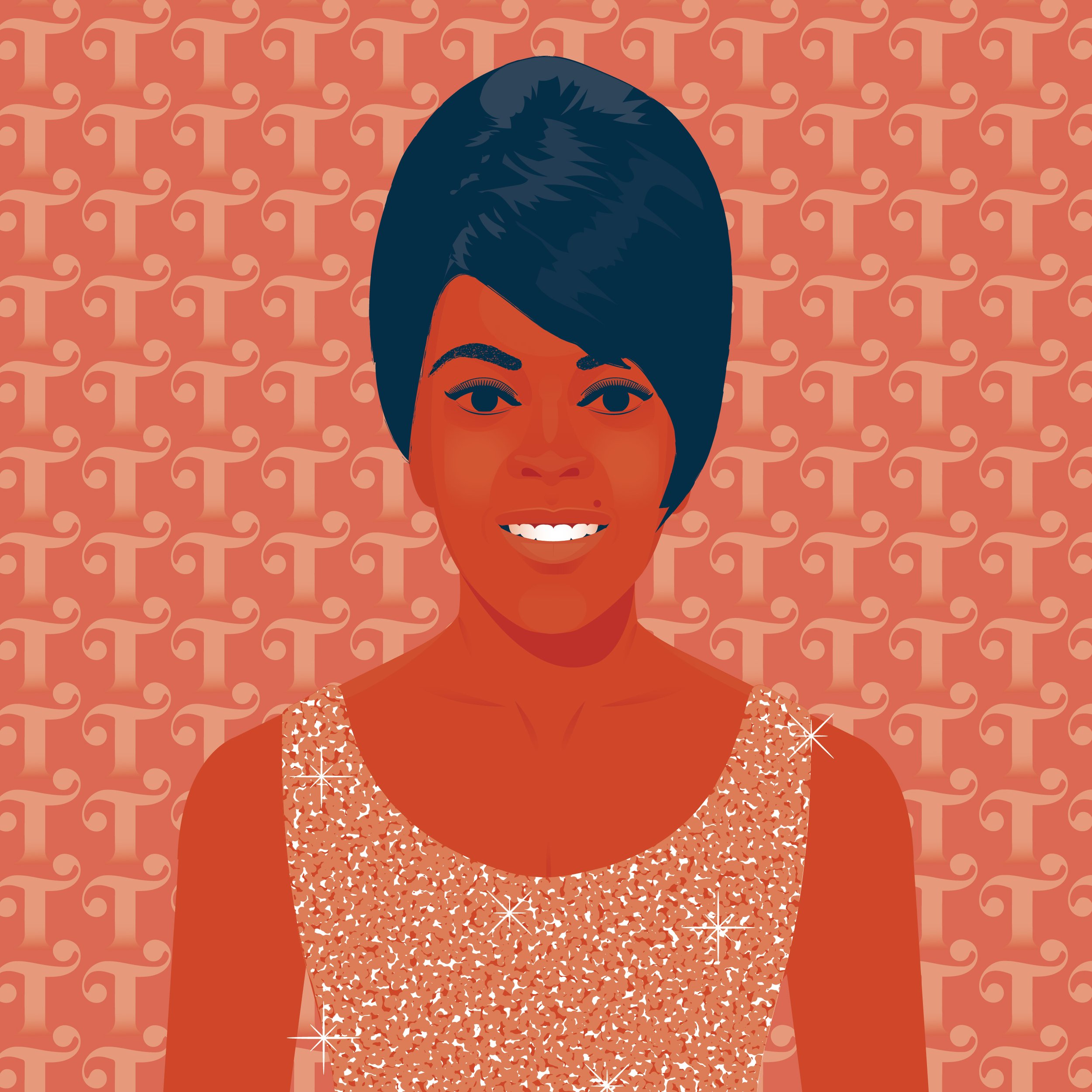
Tammi Terrell. Illustration by J.D. Humphreys
• ASHFORD & SIMPSON LEAVE A LEGACY •
As Terrell’s health declined, Ashford and Simpson stepped in vocally. “We had to become singers,” Simpson acknowledges. Conflicting accounts followed for years, but Simpson has remained clear.
"I sang things with Marvin because Tammi was not available,” she said in the docuseries Unsung. “And, then we would bring Tammi in to go over her parts. Those are Tammi Terrell vocals because we know that we went back in with Tammi and got what we needed."
Motown briefly opened a door for Simpson as a solo artist. “At Motown, there was a period where we had a whole lot of excess material and nobody in particular to put it on and that’s how I got a solo album,” she says. She remains proud of Exposed, even while acknowledging it lacked promotional support.
“I think we were more thought of as a songwriting machine—we weren’t real singers at that point,” she admits. Becoming performers was grueling. “Nick was sweating under his arms every time he hit the stage and we had towels up under him. This was hard work.”
Money remained uncertain. Simpson often recorded jingles with Patti Austin. “We were the top divas in jingles,” she laughs—work so steady she “almost didn’t have a songwriting career.”
Then came the wake-up call. Ashford rushed to Motown without her to work on a Frank Wilson record.
“I’m not going to lose my part,” Simpson realized.
Their legacy, of course, is indisputable. “You’re All I Need to Get By” dominated charts in the U.S. and the U.K. They shaped Diana Ross’s solo debut, worked with the Marvelettes, Syreeta Wright, Gladys Knight and the Pips, Smokey Robinson and the Miracles, Martha Reeves and the Vandellas, the Supremes, and the Four Tops.
“YOU’RE ALL I NEED TO GET BY” BY MARVIN GAYE & TAMMI TERRELL
It wasn’t until the end of 1974—long after the music had already bound them—that Ashford and Simpson finally married.
By then, the world already knew they were each other’s secret ingredients.