
The Supremes Put Holland-Dozier-Holland in the Hit-Making Hot Seat
SOUL SECRET INGREDIENT: HOLLAND-DOZIER-HOLLAND
If Motown was a hit factory, then its greatest innovation wasn’t just its assembly line—it was the recipe. And no team understood that recipe better than Holland-Dozier-Holland. From 1962 to 1967, Brian, Lamont, and Eddie combined their distinct strengths—composition, production, vocal arrangement, and lyric-writing—into a formula that produced some of the most enduring Soul records ever made. These weren’t just songs; they were carefully engineered blends of rhythm, story, and emotion, the secret ingredients that gave Motown its unforgettable sound.

Holland-Dozier-Holland: Brian Holland (left), Lamont Dozier (middle), Eddie Holland (right). Illustration by J.D. Humphreys
• H-D-H GETS THEIR START •
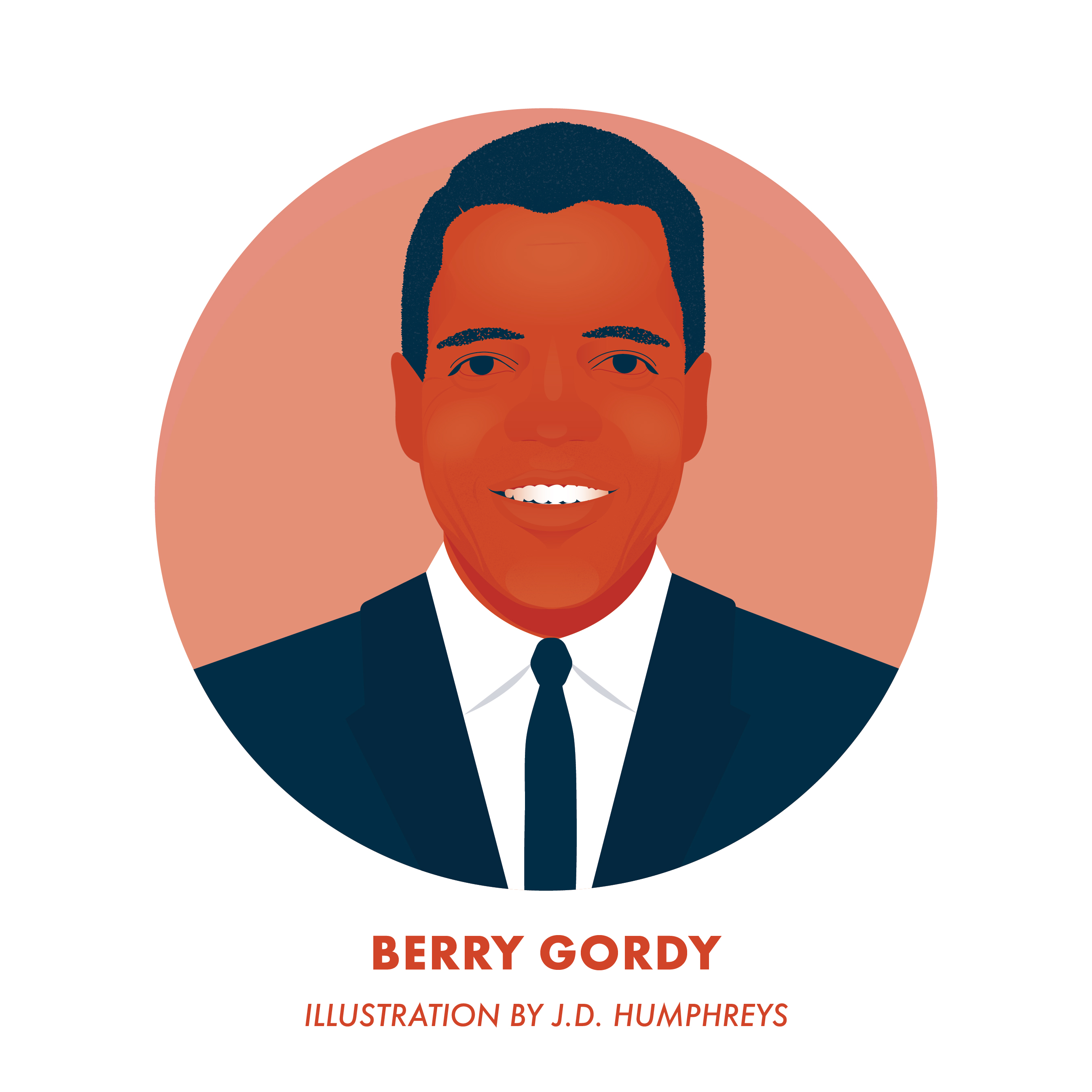
Eddie Holland knew Berry Gordy long before Motown had a name or a doorway to walk through. Back then, he was a young recording artist chasing the charts, and in 1961 he nearly caught them with a modest hit called “Jamie.” His brother, Brian Holland, was already shaping the future, co-writing “Please, Mr. Postman,” the Marvelettes’ smash that gave Motown its first real push into the national spotlight. Lamont Dozier—scribbling lyrics on scraps of brown paper bags—had bounced through a handful of labels in the fifties and early ’60s, including Anna Records, run by Gordy’s sister, and the Motown offshoot Mel-o-dy.
 Though Brian and Lamont grew up with classical music whispering in their ears, all three shared an uncommon instinct: they understood hits from every angle—melody, structure, voice, story, and the subtle electricity that ties them together. They tried performing their own material for a while, but the truth revealed itself quickly enough. Their calling wasn’t the spotlight; it was the workshop. Eddie’s crippling stage fright made the decision easier, while Lamont saw something bigger on the horizon—a chance to give rock and roll a smarter, more sophisticated backbone. Together, they stepped off the stage and into the engine room of Motown, ready to build the sound they knew the world was waiting for.
Together, their work began generating earnings that were entirely new to them. “It was very good because…I went directly to Berry I remember,” Dozier recalled. “As a kid, first thing you know, my father always talked about Cadillac cars. When I found out that was going to be getting a pretty decent check, I said, ‘Berry, you gotta give me an advance, I want to get me a Cadillac.’ He said, ‘Wait a minute, slow down, slow down. You haven’t even got yourself together yet and now you want to take your little royalty that you got coming and advance it all and buy you a car. You don’t have a decent place to stay, you going to sleep in the car?’” Young, naïve, and full of gusto, Dozier backed down—especially once he realized that, for a Top Twenty single, the money wasn’t quite as lucrative as it had seemed.
“Songwriting’s a job of work,” said Brian Holland in 1967. “We come in; we sit down; and we concentrate. I’m not trying to make it sound more simple than it is, but we’ve been working together for a long time now and we’ve got to the point where there’s a spark between us. Don’t think we write songs every week; it’s just when the inspiration gets us. We don’t push it. Sometimes it baffles me how we dream ‘em up, but I don’t think we’d have done so well without some great artists to perform our songs.”
“Sometimes it baffles me how we dream ‘em up, but I don’t think we’d have done so well without some great artists to perform our songs.”
- Brian Holland
• FRIENDLY COMPETITION INSIDE HITSVILLE USA •
Holland-Dozier-Holland weren’t just making hits—they were running a race inside Hitsville. Motown was a hotbed of talent, and Gordy knew how to stoke the fire. He fed the friendly rivalries, handing out titles like Producer of the Year and Writer of the Year to those who scored the biggest successes. For H-D-H, every session, every melody, every hook was not just about the music—it was about proving themselves, outpacing the next team, and keeping their edge sharp in a studio where greatness was expected every single day.
“Everybody strived to get those little plaques that they made up,” Dozier said. “Nobody had the exclusive rights, not really, on any artist. If you could come up with a better song for an artist, first you had to get permission to do so, you’d get that artist for at least that particular song. That’s true in a sense but in another sense, Holland-Dozier-Holland had so many songs by the Supremes and the Four Tops and Martha [and the Vandellas], that it was kind of hard for anybody to take those artists away from us or get permission to do a song on them. Berry would say, ‘Well, lemme see what you got.’ Berry would wind up screening certain things. We were like his ace in the hole and he could always depend on us with what we could come up with.”
Gordy knew that pressure from within would push everyone to raise their game. “It got kind of mean sometimes,” Dozier admitted. “Some of the guys felt like we were taking advantage of the situation. There were some talk around rumors that there were some ill feelings between some of the guys and H-D-H was getting all the releases which wasn’t really true. We weren’t getting all the releases. It was done in a healthy atmosphere though.”
“It’s like streetfighting almost. About how to win.”
- Lamont Dozier
The writers learned from each other as they shared insights and techniques openly. A friendly suggestion on how to improve upon something could go a long way but they knew at the end of the day it was on them to produce. “It’s like streetfighting almost,” Dozier said. “About how to win. There was no backstabbing, none of that stuff, but you just worked hard to try to come up with the best tune.”

The Supremes. Illustration by J.D. Humphreys
• SUPREME CHALLENGE: DELIVER US ANOTHER HIT •
Working with the singers was its own kind of battlefield. Lamont Dozier’s vision for the Supremes’ “Baby Love” was intricate, layered, precise—but Mary Wilson and Florence Ballard couldn’t quite hear it the way he did. The very voices meant to bring the song to life started to question the creative direction. Dozier’s patience was quickly fraying that night on August 13, 1964.
This wasn’t the first time the Supremes had locked horns with H-D-H over creative direction. Diana Ross had thrown a fit the first time she heard the lyrics to “Where Did Our Love Go” just months earlier, questioning whether the song would work at all. She even pulled in Gordy to take sides. And yet, against all doubts, it became their first hit.
LISTEN TO “WHERE DID OUR LOVE GO” BY THE SUPREMES
“Well, we didn’t like the songs,” Wilson said. “We hated them. Had Motown not had a force, we probably would have refused. I pulled Eddie over to the side and said, ‘Eddie, we are serious. I know we are teenagers and you guys think that we’re not serious. We’re serious about our music and we want a hit.’ He said, ‘Trust us, Mary. These will be hits.’”
Studio A was alive once again with frustration and stubbornness. Wilson couldn’t stop fixating on the repetitive rhythm of “Baby Love” as they ran through it again and again. The recent success of “Where Did Our Love Go” still hung over them, casting a long shadow of expectation—and doubt. Could H-D-H deliver another chart-topper? Diana instinctively stayed quiet this time, resisting the urge to challenge H-D-H like last time. But the tension didn’t disappear; every sigh, every whispered jab from the three girls made it clear they’ve lost trust in H-D-H.
Dozier leaned in, voice calm but firm: “Just sing ‘baby… baby…’” Wilson and Ballard hesitated, questioning the simplicity even further. Dozier exhaled, and with a quiet wry smile in his head, he said, “Just sing it, will you, please?”
Dozier remembers the tension like a physical weight. “It was a bad night for dubbing because the baby… babies… was going and it was so different. It wasn’t R&B, it wasn’t Pop, we didn’t know what it was.” The singers’ instincts clashed with the writers’ vision, and for a moment, the song teetered on the edge of collapse.
“It wasn’t R&B, it wasn’t Pop, we didn’t know what it was.”
- Lamont Dozier
The chop-chop marching rhythm they used in “Where Did Our Love Go” became the song’s heartbeat once again—a bold rhythm that tied everything together. “We ran out of ideas and it was looking like this was a total waste. We had blown it this time. Low and behold, this was like the biggest thing.”
H-D-H managed to pull it off once again. “Baby Love” gave the Supremes the distinction of being the first Motown act to have more than one American number-one single. Wilson recalls Gordy’s reaction with a laugh: “I remember Berry said, ‘See? You can’t pick a hit, Mary. So, just leave that to us.’”
LISTEN TO “BABY LOVE” BY THE SUPREMES
Wilson reflected on why H-D-H’s approach worked so well for the Supremes. They understood that the group wasn’t as naturally soulful as some of Motown’s other acts—and rather than forcing it, they leaned into the difference.

Mary Wilson of the Supremes. Illustration by J.D. Humphreys
“I think what happened with Holland-Dozier-Holland and their way of producing was very unique for us,” Wilson explained. “They were used to producing for R&B artists, really soulful artists like Martha [and the Vandellas], who was really soulful. Levi [Stubbs] of the Four Tops was really soulful. Then they applied that same technique to the Supremes, who were really not soulful. And regardless of what anyone said about the Supremes selling out and having this white sound, that was not true. We wanted to be soulful and we could not. It was not Diane’s style or my style. Florence was a bit more soulful but she didn’t sing lead so it really wasn’t a big thing. But with them producing for us, I think that turned their technique around and applied it to another medium that brought out a new philosophy, a new sound and that’s where the magic came in. Putting that R&B flavor to us and we couldn’t sing R&B, but it came out in a different way and everyone grasped it. I think that’s why we crossed over because we’re Black but we’re singing the way we sing, which was not Black, but the music was.”
“I think that’s why we crossed over because we’re Black but we’re singing the way we sing, which was not Black, but the music was.”
- Mary Wilson
Holland-Dozier-Holland weren’t just a writing and producing team—they were the heartbeat behind Motown’s most unforgettable songs. Between them, they conjured 25 number-one hits, from Marvin Gaye’s tender “How Sweet It Is (To Be Loved By You)” to the unstoppable energy of Martha & the Vandellas’ “Heat Wave.” When it came to the Supremes, they practically became the architects of their legend, penning ten of the group’s twelve chart-topping singles, including “You Keep Me Hangin’ On,” and “Stop! In The Name of Love.”