
Holland-Dozier-Holland: The Talent Motown Couldn’t Hold Onto
SOUL SECRET INGREDIENT: HOLLAND-DOZIER-HOLLAND
The Four Tops had done everything right—and still nothing was happening. By the summer of 1964, they’d been together for over a decade, signed to Motown for more than a year, and relegated to the sidelines. Backup vocals. Jazz standards. No single. No urgency. Once known as the Four Aims, they’d become the Four Tops in name but not yet in opportunity, waiting for Motown to decide they were worth the risk.

The Four Tops. Illustration by J.D. Humphreys
• BABY, WE NEED A SONG •
That late July night in 1964 at the Twenty Grand felt familiar: watching another group’s moment unfold. The Temptations commanded the nightclub while the Four Tops sat with a quiet, practiced patience.
Then Brian Holland crossed the floor over to the Four Tops with a song for them.
What followed wasn’t a meeting or a promise—it was a spark. By 1:30 a.m., the group was back at Hitsville, recording “Baby I Need Your Loving” before the night had loosened its grip on Detroit. Released two days later, the record surged to number eleven on the Billboard Hot 100 that fall, becoming the group’s first million-seller and the sound of waiting finally paying off.
LISTEN TO “BABY I NEED YOUR LOVING” BY THE FOUR TOPS
The Four Tops were not a “fly-by-night type of group,” lead singer Levi Stubbs said emphasizing the various chart successes thanks to H-D-H’s songwriting creativity and the group’s harmony. A message song of loyalty and support, “Reach Out I’ll Be There” in 1966 (a number one hit on both charts) resonated with both Black and white audiences at a unique time during the decade. H-D-H’s message was not lost to the Four Tops and Stubbs who reached the zenith of his vocal range to get it passionately across. “At that particular time, people were protesting—the hippies and what have you—and I think H-D-H were trying to make a statement,” Stubbs said. “’When you feel you can’t go on because hope is gone, just reach out and I’ll be there.’ That particular song seemed to hit all across the world. Everybody could relate to that. To me, that was their particular statement as far as that particular era was concerned. And luckily for the Four Tops, we were on the receiving end.”
“At that particular time, people were protesting—the hippies and what have you—and I think H-D-H were trying to make a statement.”
- Levi Stubbs of the Four Tops on “Reach Out I’ll Be There”
LISTEN TO “REACH OUT I’LL BE THERE” BY THE FOUR TOPS
The group insisted the song was too strange to be released once they heard the final version overdubbed with a piccolo and flute in the intro. Berry Gordy disagreed and had the song released as a single. According to Dozier, “Reach Out” was a “very innovative song” containing Bob Dylan influences.
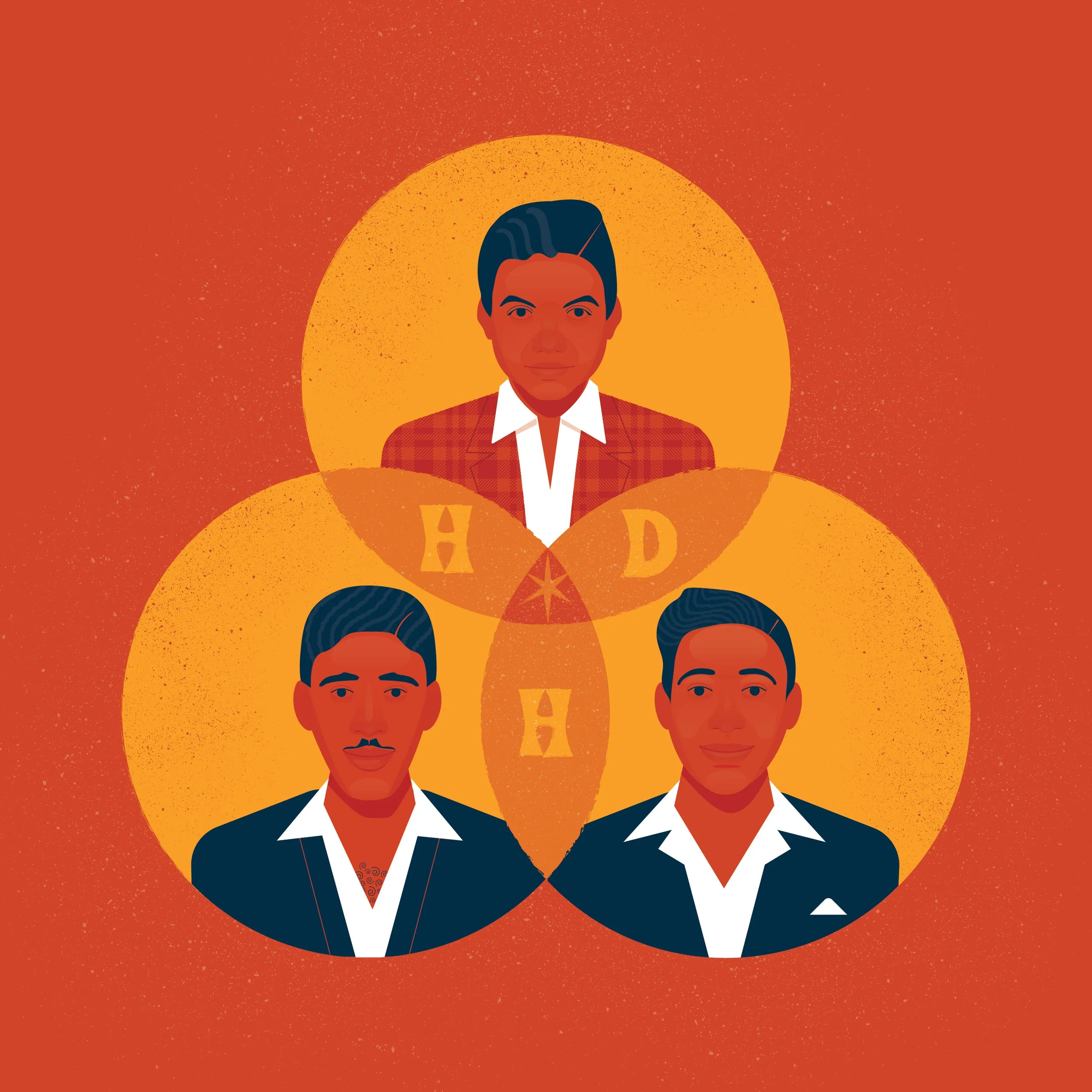
Holland-Dozier-Holland. Illustration by J.D. Humphreys
• H-D-H LEAVES MOTOWN •
Success has a way of amplifying ego—not always as arrogance, but as awareness. With every hit Holland-Dozier-Holland delivered, their value at Motown became harder to ignore and harder to contain. They were no longer just writing songs; they were shaping the company’s sound, its dominance, its future. And yet opportunity didn’t always scale with impact. When money and power enter the room, gratitude gives way to negotiation, and collaboration becomes a quiet struggle for incentives and benefits. Motown was no exception. What unfolded by 1967 wasn’t betrayal so much as a familiar human tension: how success reshapes self-worth, and how institutions respond when the talent they rely on begins to realize it.
“We wanted a bigger slice of the pie… It got to a point we felt we were in a box working for the store and the store wasn’t doing all it could do for us,” Dozier said. The team wanted publishing, wanted a label of their own, and more incentives. “With our name we thought we could do more and better and we set out to do that although we had a contract. There were some ideas brought up to us that there might be some discrepancies in the royalties that we had been paid.”
“With our name we thought we could do more and better and we set out to do that.”
- Lamont Dozier
Eddie in his recent book, Come and Get These Memories, co-written with Brian, maintains “the dispute with Motown was never really about money. Nor was it about it about copyright or royalties, or any of the material items that the lawyers made it appear we were fighting over.” He went further and claimed that Motown not paying the artists what they were due was false. Mickey Stevenson also supports this claim adamantly in his book The A&R Man.
By 1967, tensions inside Motown had reached a breaking point. Eddie quietly orchestrated a slowdown in output, a pressure tactic born of mounting frustration. One of Gordy’s decisions only deepened the rift: Eddie was appointed head of A&R, while Mickey Stevenson was shifted into the president’s office to work on special projects. It was then that Dozier began to see the fault lines clearly. The Hollands—particularly Brian, a founding figure at Motown—were negotiating from a position that could ultimately benefit them most if Gordy gave in. Gordy bristled at the mounting pressure, and it soon became evident that the trio’s demands would not be met.
Feeling left out, Dozier said, “I had gotten sort of disenchanted. I came in one day and said, ‘Guys, I’m gonna have to say farewell because I’m looking ten years ahead and I don’t see anything. I’m going to have to go out on my own.’”
Disgruntled and leaving their contracts in flux, H-D-H left Motown together and the trio set out to create their own labels. Invictus Records and Hot Wax Records had modest success working together and it looked like leaving Motown was a good path forward. “Hits are hits,” Dozier said. “It was even more because it was your company supposedly. It felt good.”
• DOING IT FOR THEMSELVES •
Musicians and singers flocked to H-D-H now that there was new alternative in Detroit headed by the very songwriters that made Motown fame and riches. For Scherrie Payne, it was an opportunity to leave teaching school. She recalled stopping in her tracks on the way to chemistry class in college years earlier in 1964 when she heard the Supremes’ “Where Did Our Love Go” drifting out of a white girl’s dorm room. She would later learn that it was H-D-H behind the hand claps and the songwriting. Payne, who would later become one of the Supremes in seventies, signed to the Invictus label as part of The Glass House in 1968 along with Ty Hunter, Larry Mitchell, Sylvia Smith, and Pearl Jones. Their first recording was “Want Ads” in 1969 but was promptly shelved. “I didn’t care for it too much,” recalled Payne. About a year later, Payne heard the song playing in the studio to find out that her vocals had been replaced by Edna Wright of Honey Cone. “She did a fabulous job on it, and ‘Want Ads’ went on to become a number one seller,” Payne said. “And that’s what set Honey Cone on their road to stardom. Like, doggone it, I blew it again!”
For her sister, Freda Payne, being signed by Holland-Dozier-Holland was a denouement of sorts, the satisfying end to a long game of cat and mouse with Motown throughout the sixties. In 1969, H-D-H set to work writing and recording “Band of Gold.” Released the following year, the song became Payne’s biggest hit and a landmark success for H-D-H’s newly formed label.
 Scherrie provided lush background vocals alongside Telma Hopkins, Joyce Vincent Wilson, and Pamela Vincent, all seasoned session singers from the Golden World and Motown studios. Instrumentation came from members of the legendary Funk Brothers, whose signature sound had powered countless hits. This wasn’t about loyalty to a company—it was the chance to work with H-D-H on bold, groundbreaking material, and that opportunity drew some of Motown’s finest talent to the project.
LISTEN TO “BAND OF GOLD” BY FREDA PAYNE
“Band of Gold” carried a certain mystique for its listeners. In the song, Payne exclaims that during the honeymoon, her lover stayed in a separate room. “The scene we envisioned was that this guy wasn’t able to make love to his new wife because he was actually gay,” Dozier reveals in his book How Sweet It Is. The storytelling was groundbreaking, coming at a time—1970—when society was far from accepting of open homosexuality. H-D-H recognized that Motown would not have been the right place to produce a song tackling such a taboo topic. With their new company, however, they had the creative freedom to take the leap. “I started thinking about what that experience might be like for the women in those situations, and that’s where the idea came from.”
Motown sued for breach of contract. H-D-H countersued which started one of the longest legal battles in music history. Jobete, the publishing unit of Motown, had a legal contract on H-D-H and therefore they were prevented from using their names on the songs they wrote and produced.
“At the time it was a damper on it because we were always fighting this war, in litigations because Motown had a lawsuit,” Dozier said. “We had a lot of fees. Lawyers really got rich off the case. We started taking money from our livelihoods to pay for the lawyer fees.”
Dropping “Holland-Dozier-Holland” altogether, they went by pseudonyms. Into the seventies, they had legal issues of their own but achieved success working with various artists. Dozier still felt held back by “the Holland situation,” especially when they rejected opportunities to sign rising artists, including signing Al Green. He left in 1973 to pursue more aspects of the entertainment business. “I wanted to branch out and diversify—be an octopus, so to speak.” Dozier became a “pop act” with songs that he had stockpiled for himself over the years. Holland-Dozier-Holland Productions would even work with Motown and its artists, including the Supremes and Michael Jackson while litigation was still pending.
A settlement with Motown came in 1977, but the story behind it was layered and deeply emotional. Years of negotiations and disputes over royalties had created tension, yet through it all, Gordy’s heart—always intended to be in the right place—guided the process and shaped countless lives, leaving a lasting mark on society and America’s music story. Time healed wounds, and the challenges of those years only highlighted the extraordinary power of what they had created together. Even amid frustration and conflict, the bonds between the Hollands, Dozier, and Gordy endured, forged through loyalty, respect, and shared history. “Take away the elements of celebrity, ego, money, contracts, conflicts, legal clashes, and interpersonal conflicts, and you’re left with a body of work that has touched the hearts of countless fans,” Dozier writes. “The songs. That’s all that matters now.”
“The songs. That’s all that matters now.”
- Lamont Dozier