
Part 2—Gamble & Huff: A Soul Keystone of Black Excellence
SOUL SECRET INGREDIENT: GAMBLE & HUFF
Before the hits, before the sound, before history attached their names to a movement, Kenny Gamble and Leon Huff were simply two young musicians chasing possibility. Philadelphia was alive with talent, stages glowing night after night, and somewhere between ambition and instinct, they were waiting for the right voice to cross their path.
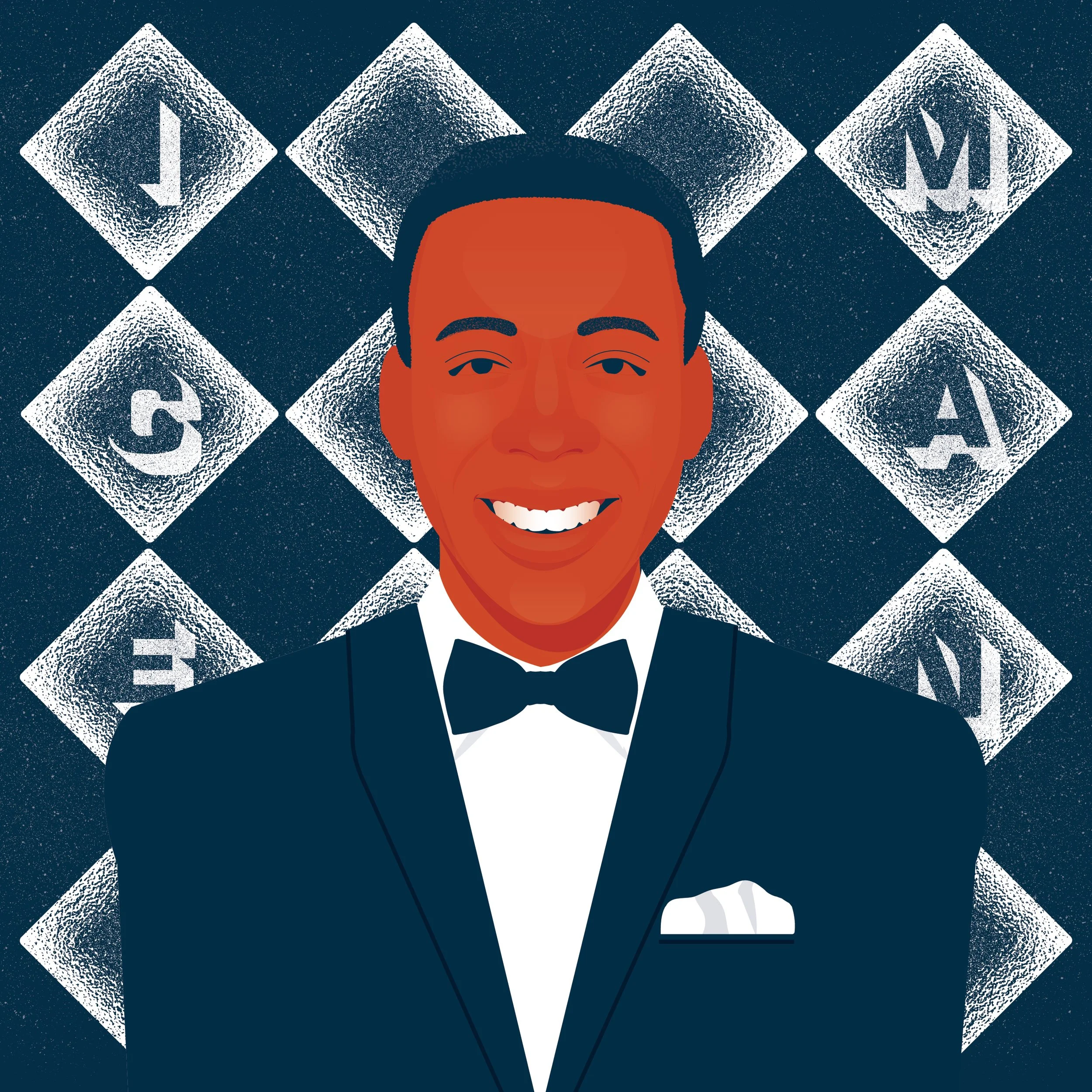
Jerry Butler. Illustration by J.D. Humphreys
• A TRIO OF BLACK CREATIVE EXCELLENCE•
One artist would change both men forever. Jerry Butler, the original lead singer of the Impressions, earned the nickname “Iceman” by Philly disc jockey Georgie Woods when the electricity went out and Butler kept singing, impressing Woods and the audience. When Butler performed at the Uptown Theater, Philly’s version of the famed Apollo, Gamble and Huff were in the wings hoping to work with him. When that opportunity came, “it was like a musical,” Huff recalls. “It was a magical carpet ride with him.”
“It was a magical carpet ride with him [Jerry Butler].”
- Leon Huff
Something clicked almost immediately. The collaboration felt less like work and more like discovery unfolding in real time. Trust formed quickly, allowing ideas to move without hesitation. “Those songs, they came quick and the beautiful part of it is that that we had a system that we had put together on how we wrote songs—we would catch everything,” Gamble said, referring to the tape recorder on top of the piano running at all times during their song development sessions.
The room became its own world—music spilling out faster than it could be contained. Gamble often freestyled at will, and as they wrote, they breathed so much life into a song that they could almost hear the finished product even before going into the studio.
Gamble and Huff found more than a collaborator with Butler — they found momentum. Together, they created Butler’s most successful single, “Only the Strong Survive,” a record that captured both grit and elegance when it was released in 1968. The song climbed to number four on the Pop chart and claimed the number-one spot on the R&B chart in 1969, becoming the centerpiece of his album The Ice Man Cometh. The album itself proved just as powerful, reaching number two on the R&B album chart and number 29 on the Pop albums chart, confirming that something special was unfolding between artist and writers. Even Elvis Presley would record his own version of “Only the Strong Survive” later that same year — a testament to the song’s reach beyond soul music’s core audience.
LISTEN TO “ONLY THE STRONG SURVIVE” BY JERRY BUTLER
But the success told only part of the story. What made the partnership remarkable was how rare it was. “I’m one of the few artists that they ever sat down to write songs with,” Butler said, pointing to a collaboration that broke from Gamble and Huff’s usual process of writing independently for performers. With Butler deeply involved, albums The Ice Man Cometh and Ice on Ice carried a distinct creative energy shaped by shared vision rather than simple interpretation. “I think even as I listen to the album today, it was definitely one of my better projects and I attribute it to their genius. Leon Huff and Kenny Gamble—very, very talented brothers.”
The chemistry between the three men blurred the lines of individual authorship, replacing ego with shared purpose. Their creative partnership thrived not on credit, but on trust — each contribution folding seamlessly into the next until the music belonged to all of them. The results spoke for themselves, yielding work that would stand among soul music’s most enduring achievements. “We never dealt with who made the contribution, we just said everybody gets a third and that’s how we rolled,” Butler said.
“We never dealt with who made the contribution, we just said everybody gets a third and that’s how we rolled.”
- Jerry Butler
• A SOULFUL PHILLY BLACK ENTERPRISE •
As their partnership deepened, Gamble, Huff, and Butler were helping shape something larger than hit records. Together, they advanced a growing vision of Black enterprise — one where the singer, composer, and writer operated as creative equals — at a moment when the industry itself was shifting beneath their feet. The once-dominant New York Brill Building Sound was losing its footing, struggling to recreate earlier triumphs in a rapidly changing consumer market. The college-sweetheart partnership of Carole King and Gerry Goffin had dissolved, bringing their celebrated songwriting era to a close, and in the wake of the British Invasion, a gradual exodus from the Brill Building began.
Philadelphia, too, was in transition. Cameo-Parkway Records, long a local powerhouse, shuttered in 1967 following a series of leadership missteps, artist defections, and creative stagnation. Yet amid industry uncertainty, Gamble and Huff’s rising success signaled that a new direction was emerging. By the end of the decade, their vision for what would become known as the Philly Sound felt not nostalgic, but perfectly in step with the evolving tastes of listeners.
A pivotal moment came during a 1967 trip to Motown, where the scale of Berry Gordy’s achievement left a lasting impression. Having built a self-sustaining empire centered on Black artistry, Gordy became both inspiration and proof of what was possible — a visit Huff would later regard as a career highlight. Gordy, recognizing a shared ambition, later reflected, “I knew their goal was the same as my goal. It was to raise awareness of great, Black artists. So we had a bond, even though they were fierce competitors.”
“I knew their [Motown’s] goal was the same as my goal. It was to raise awareness of great, Black artists.”
- Leon Huff
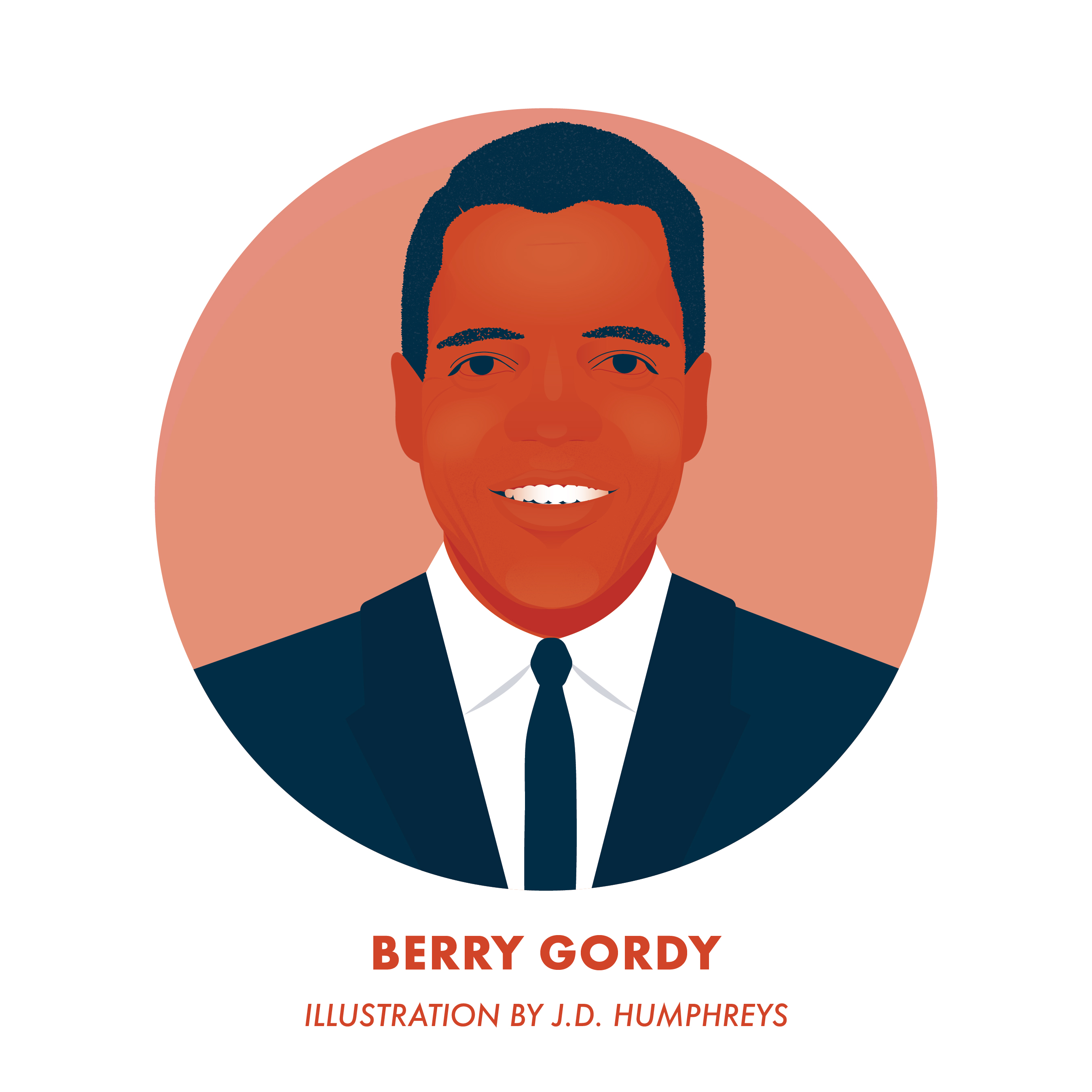 During that same trip, Gamble and Huff crossed paths with Holland-Dozier-Holland, Motown’s powerhouse songwriting team, who were themselves only months away from leaving the label amid growing frustration. The encounter reinforced what Gamble and Huff were already beginning to understand: creative success meant little without ownership.
When they returned to Philadelphia, their path forward felt unmistakably clear. If they were going to build something lasting, they would have to control it themselves — not just the sound, but the business behind it. “I think Berry had a lot of problems with that, you know,” Huff said. “We couldn’t understand the philosophy of going to toil and beat our heads against the wall to write a song and just give it away. We didn’t see it like that, and we didn’t enter the music business like that. We always owned a piece of our songs or all of it.”
For Gamble and Huff, ownership was more than a financial decision; it was an assertion of independence. Control over publishing and masters had increasingly become a pathway toward Black empowerment within the music industry, echoing the vision Sam Cooke had championed years earlier through his company, SAR Records — a model that framed artistic ownership as both economic freedom and cultural self-determination.
• CREATIVE INDEPENDENCE •
Owning their work was only the beginning. With control came the freedom to trust their own instincts, allowing Gamble and Huff to shape every creative decision without interference. Their independence as songwriters naturally evolved into independence as producers and decision-makers — a quiet but radical shift in an industry built on layers of approval.
At a time when most record labels relied heavily on Artists and Repertoire executives to dictate creative direction, Gamble and Huff saw the role as an unnecessary barrier between the music and the people creating it. “He ain’t never wrote a hit in his life, and he’s going to tell me and Gamble that he don’t like the way the horns sound,” Huff said of the idea of an A&R person which Gamble and Huff both fulfilled. “And me and Gamble thought that was a joke, so we never went through A&R people. We had our own, we made our own decisions, which made it great.”
“We never went through A&R people. We had our own, we made our own decisions, which made it great.”
- Leon Huff
By removing that middle layer, they guaranteed not only their sound but their vision — building a creative process driven by artists themselves rather than industry gatekeepers.
Gamble and Huff understood that innovation often began with curiosity. Their pursuit of a distinct sound wasn’t confined to songwriting or production choices; it extended into experimentation itself. In one memorable moment, Huff decided the office piano needed to sound different — even if it meant dismantling it entirely, much to Gamble’s alarm.
Huff carefully took the instrument apart and fitted it with flat metal thumbtacks, transforming its mechanics in search of something new. “And I loved it,” Huff said, meticulously placing the thumbtacks behind all eighty-eight hammers so they would rebound faster against the strings. “And it created a whole different sound. And I used that pedal on the piano as a backbeat, to keep the time down. That’s the way I rocked on that piano.”
What might have seemed unconventional became another step toward defining a signature style — proof that the Philly Sound was being built not only through collaboration and vision, but through fearless experimentation.
LISTEN TO “HEY, WESTERN UNION MAN”
By 1969, the foundation was firmly in place. Gamble and Huff had built more than a working partnership; they had created a brotherhood grounded in shared vision and trust. The artists were coming, the hits were multiplying, and their instincts as businessmen were sharpening alongside their creative success. Strong relationships with gifted engineers and musicians, reliable access to studios, and an expanding catalog of records signaled that something larger was taking shape — not by accident, but by accumulation.
LISTEN TO “ONE NIGHT AFFAIR” BY THE O’JAYS
Yet even as success accelerated, its scale felt almost impossible to explain. “One hit after another it was and when people ask me, I say it was a miracle because there is no way to explain how it happened—it just happened,” Gamble said. “We happened to be the one who really motivated the whole fest of the Philly Sound. We pushed it. We promoted it and we wanted it to the sound of Philadelphia, the Philly sound. We wanted it to be that.”
What had begun as collaboration was now becoming identity — a sound tied not just to records, but to a city ready to hear itself differently.
• PHILADELPHIA INTERNATIONAL RECORDS •
Success eventually demanded more space — and with it, a difficult goodbye. The sixth floor of the Shubert Building had been more than an office for Gamble and Huff; it was where their ambitions first took shape, where ideas were tested, songs were born, and a partnership became a movement. Every late-night session, every experiment, every breakthrough echoed within those walls. Leaving meant acknowledging that the dream they had built there could no longer be contained.
They moved to 309 South Broad Street, into the former offices and studios of Cameo-Parkway Records — a symbolic passing of the torch inside Philadelphia’s music history. The address carried its own legacy, once home to a powerhouse that had defined an earlier era of pop success. Now, Gamble and Huff were stepping into that space not as hopeful writers, but as architects of something new.
 After years of working under other labels and crafting hits for artists like Dusty Springfield, Wilson Pickett, Nancy Wilson, and Joe Simon, they understood the moment clearly: it was time to build their own company. As plans for Philadelphia International Records took shape, they reached back to the collaborator who had helped ignite their rise, offering Jerry Butler a chance to join them — possibly as a partner or executive.
But timing, as often happens in music history, intervened. Butler remained bound to Mercury Records for three more years, representing nearly fourteen percent of the Chicago label’s sales and making any departure certain to trigger a legal battle. “Had I been able to move with them, I would have been there in a heartbeat and probably there would have been a different—oh, I’m sure—there would have been a different direction to my career,” Butler added.
Gamble and Huff moved forward without him. The collaboration that had helped shape their ascent came to a quiet close, even as the next chapter — larger, riskier, and entirely their own — was just beginning.
What followed was nothing short of a musical revolution. Through Philadelphia International Records, Gamble and Huff unleashed an extraordinary run of hits throughout the 1970s — records that didn’t simply climb charts but reshaped the emotional and cultural language of popular music. “Back Stabbers,” “Love Train,” and “For the Love of Money” by The O’Jays, “If You Don’t Know Me By Now” by Harold Melvin & the Blue Notes, and “Me and Mrs. Jones” by Billy Paul became more than songs; they became shared experiences, carried across radios, dance floors, and city streets around the world.
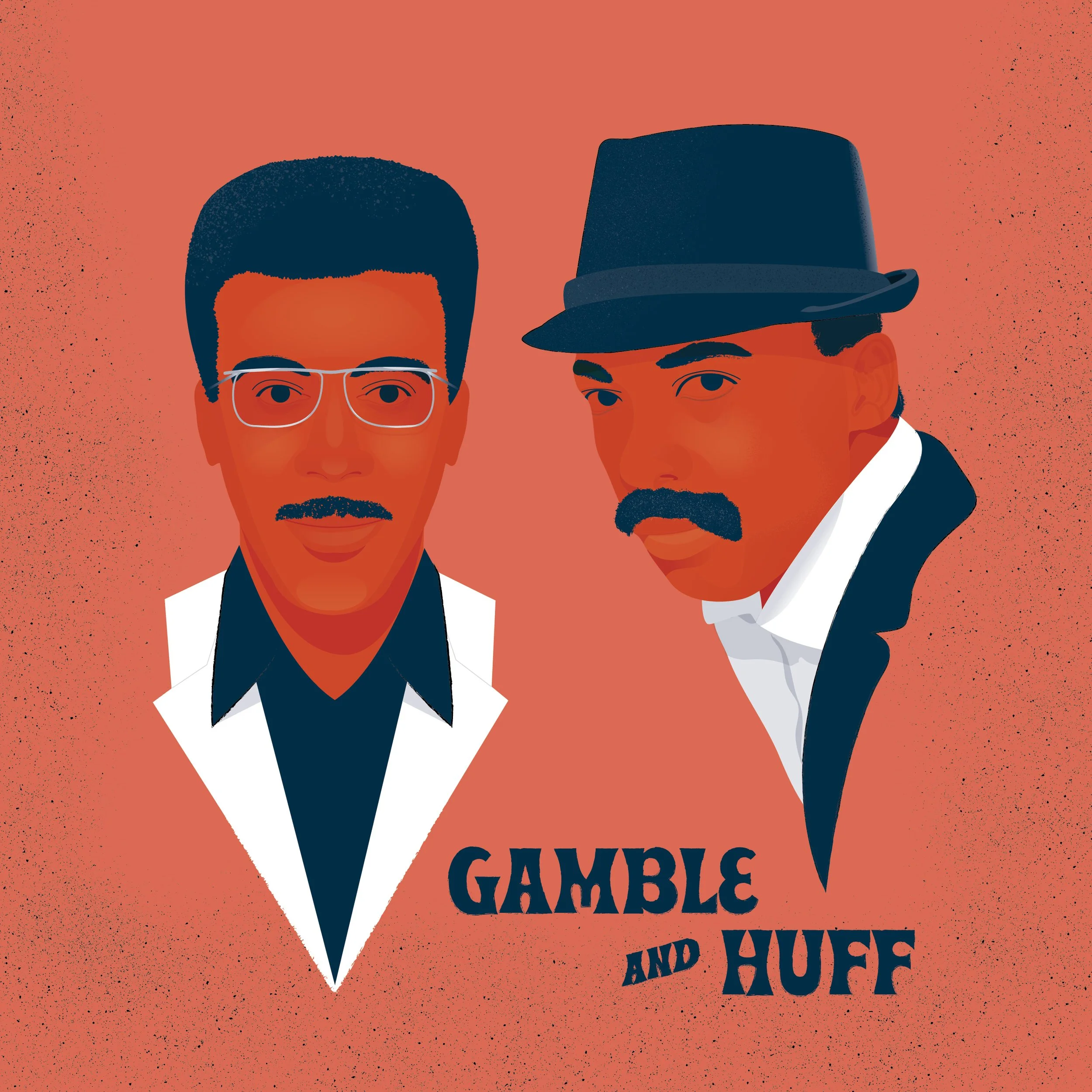
Kenny Gamble & Leon Huff. Illustration by J.D. Humphreys
• TURNING BLACK BROTHERHOOD INTO A SOUND •
But the music evolved alongside the moment. Moving beyond the uplifting romanticism that marked much of their earlier work, Gamble and Huff began weaving sharper social and political awareness into their records, giving voice to the realities and aspirations of the Black community during a decade of profound change. Their sound carried both celebration and conscience — joy alongside truth.
Over the course of their careers, Gamble and Huff would write more than three thousand songs, a body of work almost impossible to measure in influence or reach. Yet the partnership itself remained constant. Decades later, they continue to write together from their homes in Philadelphia, still guided by the same trust and shared purpose that first brought them together.
“Black music is so powerful and so strong and so universal to everyone that it knocks down all the odds every time,” Gamble said.
And perhaps that is the truest legacy of all: in the City of Brotherly Love, two collaborators turned Black brotherhood into sound — creating music that carried Philadelphia’s spirit to the world and ensured that its heartbeat would never stop playing.
“Black music is so powerful and so strong and so universal to everyone that it knocks down all the odds every time.”
- Kenny Gamble
Jerry Butler Jr.
December 8, 1939 – February 20, 2025