
SOUL SECRET INGREDIENTS: LOUVAIN DEMPS, JACKIE HICKS, MARLENE BARROW
There’s a particular kind of voice—the kind that doesn’t demand the spotlight, but somehow makes everything around it glow brighter. The kind that can slip into a song, lift it, smooth it, and leave no fingerprints behind. At Motown Records, that kind of voice wasn’t just admired—it was expected. Songwriters were credited. Artists were celebrated, even when their leads were quietly reinforced or replaced. But there was another presence, woven into the fabric of hit after hit, that rarely saw its name in print. The Andantes were Motown’s best-kept secret ingredient. Pick up nearly any record from the label’s golden era, and you’re likely hearing them—shaping, sweetening, and elevating thousands of tracks while remaining largely invisible, their contributions absorbed into the legend as others stepped forward to claim it.
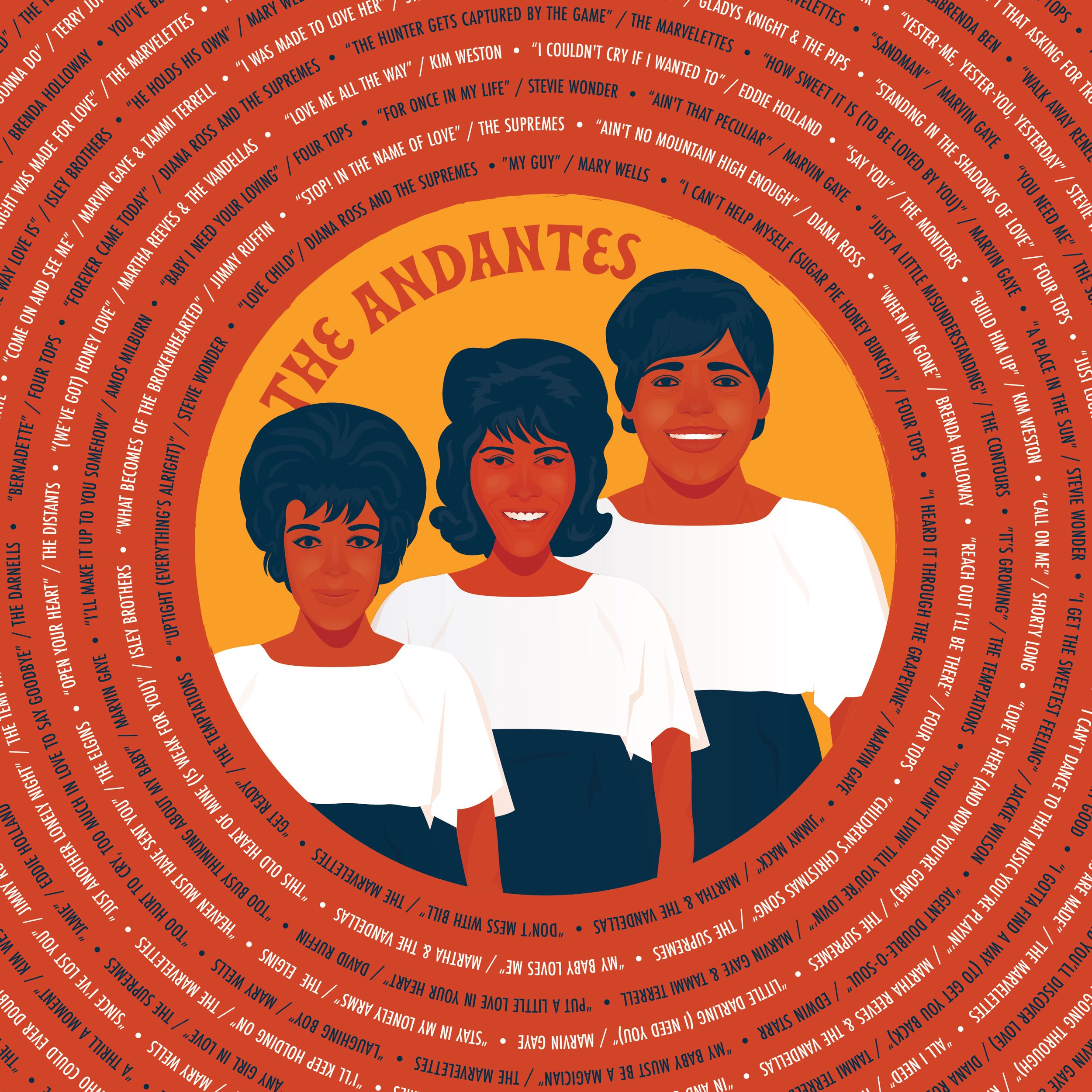
Marlene Barrow, Louvain Demps, Jackie Hicks. Illustration by J.D. Humphreys
• AUTHOR’S NOTE •

Call it kismet, but nearly fourteen years ago—when this book (ahem, blog) was little more than a few rough illustrations and a lot of curiosity—I was introduced to Louvain Demps by the late Al Abrams. I admired her extraordinary contributions to Motown long before I knew her personally, but what began as a shared interest in music grew into a friendship I've come to treasure. Over the years, Louvain has generously shared her memories, offered encouragement for my work, and become a welcome and consistent presence in my life. She's one of my favorite people, and finally meeting her and her son, Michael, in person in 2024, after so many years of knowing her, was an experience I'll always cherish.
Now, in 2026, as Louvain prepares to tell her own story in her forthcoming book, scheduled for release on December 1, the timing feels especially meaningful as Divided, We Danced finally reaches the Andantes' chapter in Motown history. Much of what follows has been informed by Louvain's generosity, our conversations, and my own research. It is by no means a substitute for her story, which is hers to tell. Rather, it's an opportunity to celebrate three extraordinary women, share some of what I've learned along the way, and encourage readers to discover more from someone who was there to experience it firsthand.
• THE RAYBER VOICES •
Talent like Louvain Demps’ doesn’t come from a single place—it’s shaped, layered, and lived in. For her, music wasn’t an interest; it was part of her environment. It came through the church, through family, and through the unexpected proximity to talent that quietly changes what feels possible. She was already indirectly connected to the world she would one day enter.
One of those early connections came through her neighbor, Mrs. Potter—known as “Sugar”—a hairdresser whose reach extended far beyond the beauty parlor. Through her, Demps was introduced to Maxine Sullivan. At the time, she didn’t fully grasp just how established Sullivan was. That understanding would come later. What stayed with her, though, was the advice—words that would settle in early and echo long after the moment passed.
Louvain Demps wasn’t exactly chasing a career opportunity—she was just helping her friend bring a song to life. After spotting a newspaper ad offering a $100 recording session, Louvain stepped in to record a demo on her behalf, making her way to Rayber Voices—the studio run by Raynoma Gordy and Berry Gordy—a precursor to what would later become the Andantes’ world of work.
“It got me a record demo, you might say,” she said. “And the audition that I was not taking for myself. The record wasn’t for me but for my friend Rhoda Collins. She actually wrote the poem and they put it to the music. Because she could not sing, she asked me to demo it for her. It would cost one hundred dollars to actually make the record. With my husband at the time, we paid the hundred dollars.”
During that session, Demps did more than sing—she revealed a range and control that stopped the room. The team at Rayber Voices heard it immediately and signed her on. At the same time, Raynoma Gordy—the group’s lone female voice—was being pulled deeper into the growing demands of what would become Motown Records. The timing couldn’t have been more precise. Demps stepped in and, almost seamlessly, became the voice that completed the sound.
You can hear her in those early, foundational recordings—on “Money (That's What I Want)” by Barrett Strong and “Because I Love Her” by Eddie Holland—records that helped define Motown as it found its footing. And even then, her voice wasn’t confined to one studio. Demps was already building a career that extended beyond Motown’s walls, moving wherever the music called for her.
LISTEN TO “MONEY (THAT’S WHAT I WANT)” BY BARRETT STRONG
A lot shifted quickly after that audition—just not all in one direction. While Demps stepped into the orbit of what would become Motown Records, she was also building momentum elsewhere. She successfully auditioned for Bobbie Smith & The Dream Girls, recording sides like “Mr. Fine” and “Wanted” in 1961 and the clever answer record “Duchess of Earl,” a response to Gene Chandler’s “Duke of Earl.” Between performances in New York and appearances on the record hop circuit, her career was already in motion.
LISTEN TO “DUCHESS OF EARL” BY BOBBIE SMITH & THE DREAM GIRLS
• THE QUIET TAKEOVER OF THE ANDANTES •
Back in Detroit, things were evolving. The Rayber Voices were being called on less frequently as Motown’s sound began to expand—not necessarily to improve it, but to make it feel bigger, fuller, more layered. It was Richard Wylie—better known as “Popcorn”—who helped set the next chapter in motion, introducing Demps to Marlene Barrow and Jackie Hicks. Together, they became the Andantes.
What followed was less of a slow build and more of a quiet takeover. As studio demands increased, the Andantes proved not only precise but incredibly fast—able to step in, adapt, and deliver. They weren’t positioned as stars; they were there to widen the sound, to fill it out, to give records a sense of scale. But in doing so, they became indispensable. They rounded out—and at times replaced—the Marvelettes in the studio, sweetened the the Four Tops, enhanced the Supremes, and left their vocal imprint across countless recordings. But that trajectory did not come without feats of resilience and working with an ambitious company.
“It was difficult to work with Berry Gordy,” Demps recalls. “You would have to do things over and over and over and over again. You could be there for hours doing the same tune because he thought you could do it better.”
“It was difficult to work with Berry Gordy.You would have to do things over and over and over and over again.”
- Louvain Demps
As Motown’s roster grew and its artists began finding their footing, the Andantes became an increasingly important part of the hitmaking machinery. Their voices added depth and fullness to recordings, sometimes reinforcing the artists whose names appeared on the labels and other times replacing their vocals altogether. It was a practice that didn’t go entirely unnoticed, although the artists themselves weren’t always aware of just how much of the Andantes they were hearing on their own records.
Demps recalls, “At the time I don’t think it really bothered them. Later on it did. I think they were just excited getting out there and performing more so than being in the studio. Some of them recorded with us in the studio but their mics were turned down and ours were turned up. So it was all mixed together. Sometimes they didn’t know they were doing that until sometime later.”
Even British Motown fan club founder Dave Godin could hear the difference. “Incidentally, Marvin [Gaye] has a new female backing group—the Andantes,” wrote Godin. They were on Marv’s ‘You’re A Wonderful One,’ but there was one of the Supremes on that session. When ‘Wonderful One’ was issued, I wrote to Berry saying I thought I heard a Supreme on the disc.”
LISTEN TO “YOU’RE WONDERFUL ONE” BY MARVIN GAYE
Once the secret was out, some egos did not like it. “It was later in the years when we ever heard any remarks about it. It was one particular group that I heard was dissatisfied,” Demps said. “My comment to them was, ‘Well, you got to wear the pretty clothes. You got to go out there and you got the residuals.’ That was before we started getting them [the residuals] because it was supposed to be a secret. My thing was you got paid for work you didn’t do so why even be angry?”
Motown’s artists and groups were eager to hit the road, performing for packed auditoriums, building loyal fan bases, and introducing new songs they hoped would become the next big hits. The Andantes, meanwhile, generally stayed behind at Hitsville, where the work was hardly slowing down. Their contributions went well beyond adding rich harmonies or filling out a chorus. Often, they helped lay the vocal foundation of a recording, establishing the harmonies, phrasing, and structure before the featured artist ever stepped up to the microphone. By the time the singer arrived, much of the groundwork had already been done.
“If we went out on the road, who would be doing the background?” Demps pointed out. “When they [the groups] came off the road they needed to learn the new material and do it quickly. We worked very quickly ourselves — all they had to do was learn the material. They didn’t have to be in the studio for hours and hours.”
Demps is quick to point out that despite the occasional vocal substitutions, there was no animosity between the Andantes and the artists they supported. Inside the studio, they worked together with a shared commitment to making the best record possible, regardless of whose name would ultimately appear on the label. “It’s always good when you work with people and they appreciate you. A lot of times they didn’t want us to say anything because the Supremes were supposed to be the Supremes, the Marvelettes were supposed to be the Marvelettes, the Velvelettes, Martha & The Vandellas. When you lend your artistry to theirs, it enhances everything. It’s nice for someone to say, ‘Thank you.’”
“If you wanted your records to be great, you had the Andantes singing on them,” said Mickey Stevenson in the book, Motown from the Background by Vickie Wright. Stevenson was head of Motown’s A&R (Artists and Repertoire) department who also helped organize and establish the in-house session musicians, the Funk Brothers.
Stevenson adds, “I would take the Andantes and put them off stage with microphones, behind the curtain. You have to enhance what is happening on stage. When it came to producing records, it is a fact that the Andantes recorded on everyone’s product, from the Four Tops to the Supremes; they did everything. They did it all and they were really unsung heroines.”
“If you wanted your records to be great, you had the Andantes singing on them… they did it all and they were really unsung heroines.”
- Mickey Stevenson, Head of Motown’s A&R Department
• CLIPPED WINGS •
It's hard not to wonder what might have happened had the Andantes been given the opportunity to step out from behind the curtain and into the spotlight. They certainly had the talent, versatility, and vocal chemistry to hold their own as a girl group. Instead, their gifts were largely put to work making other artists sound their best. Marlene Barrow even stepped in for Florence Ballard during live performances with the Supremes, proving that the Andantes' talents weren't confined to the recording studio. Yet, for all their contributions to Motown's success, the prospect of launching the Andantes as recording stars in their own right was never seriously pursued by the label's management. One can only imagine what they might have achieved had someone given them that chance.
Unlike some of Motown’s more outspoken artists, the Andantes weren't inclined to challenge Berry Gordy or push management for greater opportunities. Grateful to be working in an industry they loved, they rarely made demands, even as they watched other groups enjoy the glamor and fame. Demps, who describes herself as painfully shy and reserved during those years, did eventually find the courage to approach Gordy about the group's future. She wanted more for the Andantes than a career spent almost entirely behind the microphone at Hitsville. But the conversation made it clear that management had little interest in changing their role. “I wanted us to do more and to be able to travel like some of the other people did. But that was a no-no. And at that time, I did approach him but he had kind of an attitude of ‘If you don’t like it...,’ you know. So we just did what we did.”
For years, the Andantes were told by Motown staff to be patient. Their opportunity would come. In 1964, it appeared the label was finally making good on that promise with the release of “(Like A) Nightmare,” backed by the rather forgettable “If You Were Mine.” But there was a curious catch: although the record carried the Andantes’ name and featured their harmonies, not one of the three women sang lead. That distinction went to Ann Bogan, who would later join the Marvelettes.
And what a missed opportunity. “(Like A) Nightmare” had plenty going for it: an infectious uptempo arrangement, sharp horn riffs, punchy drumming from Lamont Dozier, and a saxophone that practically takes command halfway through. It had all the ingredients of a Motown hit, including a songwriting credit from the formidable Holland-Dozier-Holland team. One can't help but wonder whether the record might have fared differently had a more established group's name appeared on that 45. For the Andantes, who had spent years helping other artists make hits, their long-awaited moment in the spotlight came with the peculiar irony of someone else singing lead.
LISTEN TO “(LIKE) A NIGHTMARE” BY THE ANDANTES
“I never really liked it, personally,” Demps said. “I just didn’t like the record. It was nice having your name on there. I think because it was kind of patterned after ‘Heat Wave,’ that was a good idea but if we had done something else, it might have been a little more exciting.”
“(Like A) Nightmare” received little promotion or distribution. Whether Gordy was reluctant to risk losing his indispensable background singers or simply had other priorities remains a matter of speculation. After all, 1964 was the year the Supremes exploded into superstardom, commanding an enormous share of Motown's attention and resources. And perhaps therein lies the logic: the more valuable the Andantes became behind the scenes, the less incentive Motown had to move them out front. As long as their voices remained available to support the label's biggest stars, the hitmaking machinery could keep humming along.

The Marvelettes (Ann Bogan, Wanda Young, and Katherine Anderson). Illustration by J.D. Humphreys
• HEARD BY MILLIONS, KNOWN BY FEW •
With a single they couldn't fully call their own and little chance of seeing it climb the charts, the Andantes returned to the work Motown valued them for most: making other artists sound extraordinary. But their talents weren't exclusive to Hitsville. Like the Funk Brothers, the Andantes found opportunities beyond Motown's walls, lending their voices to recordings for competing labels, including Jackie Wilson's electrifying “(Your Love Keeps Lifting Me) Higher and Higher” on Brunswick Records.
LISTEN TO “(YOUR LOVE KEEPS LIFTING ME) HIGHER AND HIGHER” BY JACKIE WILSON
Gordy, however, wasn't particularly enthusiastic about his talent moonlighting for the competition. As Motown's success grew, so did the label's determination to protect the people responsible for its distinctive sound. Gordy reportedly relied on staff and even fellow artists to serve as snitches, keeping management informed about who might be lending their talents to competing labels. The concern was understandable from a business perspective: competing labels would have been eager to capture even a fraction of Motown's hitmaking magic. The Andantes were valuable enough to keep from the competition, yet not valuable enough to receive the recognition they deserved. Motown had three extraordinary songbirds, but rather than let them spread their wings, the label seemed determined to keep them clipped.
Despite their enormous contributions, the Andantes received little recognition on record sleeves, no songwriting royalties for their vocal performances, and limited leverage to negotiate better terms. They were hardly alone. Many of Motown's young performers, some barely out of high school, signed contracts without fully understanding the long-term financial implications. The arrangements overwhelmingly favored the label, leaving artists with far less control over their work and earnings than their success might suggest. For the Andantes, the contradiction was especially striking: Motown depended on their voices to create its biggest hits while offering them few opportunities to build a name of their own.
Try listening to a string of Motown hits without hearing the Andantes. It's practically impossible. Their voices are woven into the very fabric of the Motown Sound, from Mary Wells’ “My Guy” and the Marvelettes’ “The Hunter Gets Captured by the Game” to Marvin Gaye’s unforgettable “I Heard It Through the Grapevine.” These weren't merely background harmonies filling the spaces between verses. They were an essential part of what made those records so extraordinary.
LISTEN TO “MY GUY” BY MARY WELLS
And sometimes, one voice was all it took. On the Supremes’ “Love Child,” Barrow and Hicks missed a high note, leaving Demps to punch it in alone. What emerged was a soaring, almost primal howl that cut through the arrangement with far more drama than the intended three-part harmony might have achieved. Gordy heard it and immediately gave his approval. A moment that could have been considered a mistake became one of the recording's most electrifying flourishes. That's the remarkable thing about the Andantes: individually, they could deliver something unforgettable. Together, they were a force of nature.
LISTEN TO “LOVE CHILD” BY DIANA ROSS AND THE SUPREMES
(Louvain comes in at 17 seconds)
“I listen to a lot of the harmonies that we did and I particularly liked the first album we did with Mary Wells, the My Guy album,” Demps said. “They were old standards but the harmony was just tight and beautiful. I feel like I’m bragging but these two women — Jackie and Marlene — were the best singers I ever sung with.”

Marvin Gaye. Illustration by J.D. Humphreys
• “WHAT’S GOING ON” •
When Marvin Gaye recorded “What’s Going On” in 1971, he performed it a year later at the Kennedy Center in Washington, D.C., also Gaye’s hometown. There, the Andantes had the biggest stage presence of their careers.
“In fact, that was the only time we were out with him,” Demps recalls. “It was the most exciting thing because I stood right next to the piano. We were friends and we lived right around the corner from one another. Our friendship was one where he talked to me about things — the recording industry, about Tammi [Terrell], and he could share with me and I could share with him. He called, himself, to get Jackie, Marlene, and me to get us to the Kennedy Center. They [Motown] wasn’t too big on us getting out on the stage.”
LISTEN TO “WHAT’S GOING ON” BY MARVIN GAYE
In 2012, John Legend took the stage at the Kennedy Center to perform Marvin Gaye’s “What’s Going On,” commemorating the 40th anniversary of Gaye’s historic performance as part of the youth campaign What’s Going On… Now. Sitting in the audience was Demps. As he sang, she was transported to another time, struck by how remarkably he captured the voice and spirit of the man she had once recorded alongside.
“I was excited that he was wanting to meet me backstage,” Demps said. “Having recorded with Marvin, I told him that he really captured him. It’s like I could close my eyes and see him there. I didn’t know whether I should laugh or cry. I did both.”
“It’s like I could close my eyes and see him there. I didn’t know whether I should laugh or cry. I did both.”
- Louvain Demps
There’s something beautifully poetic about that moment. A woman who spent so much of her career lending her voice to other people’s records was now sitting in the audience, hearing that music come alive again through another generation of talent.
And perhaps that’s what makes the Andantes’ story so remarkable. For decades, their voices have been woven into the soundtrack of our lives, filling songs we’ve sung along to, danced to, fallen in love to, and turned to when words alone weren’t enough. We knew the melodies. We knew the harmonies. We knew every soaring note, even if we never knew the women behind them.
The Andantes were the voices we didn’t know by name, yet somehow, we’d loved Marlene, Jackie, and Louvain all this time.
Marlene Barrow
September 25, 1941 – February 25, 2015
Ann Bogan
March 27, 1941 – August 6, 2026